Daily Pulse · · 08:30 NY · 7 min read · market

In this edition
And it didn't take another crash to end it.
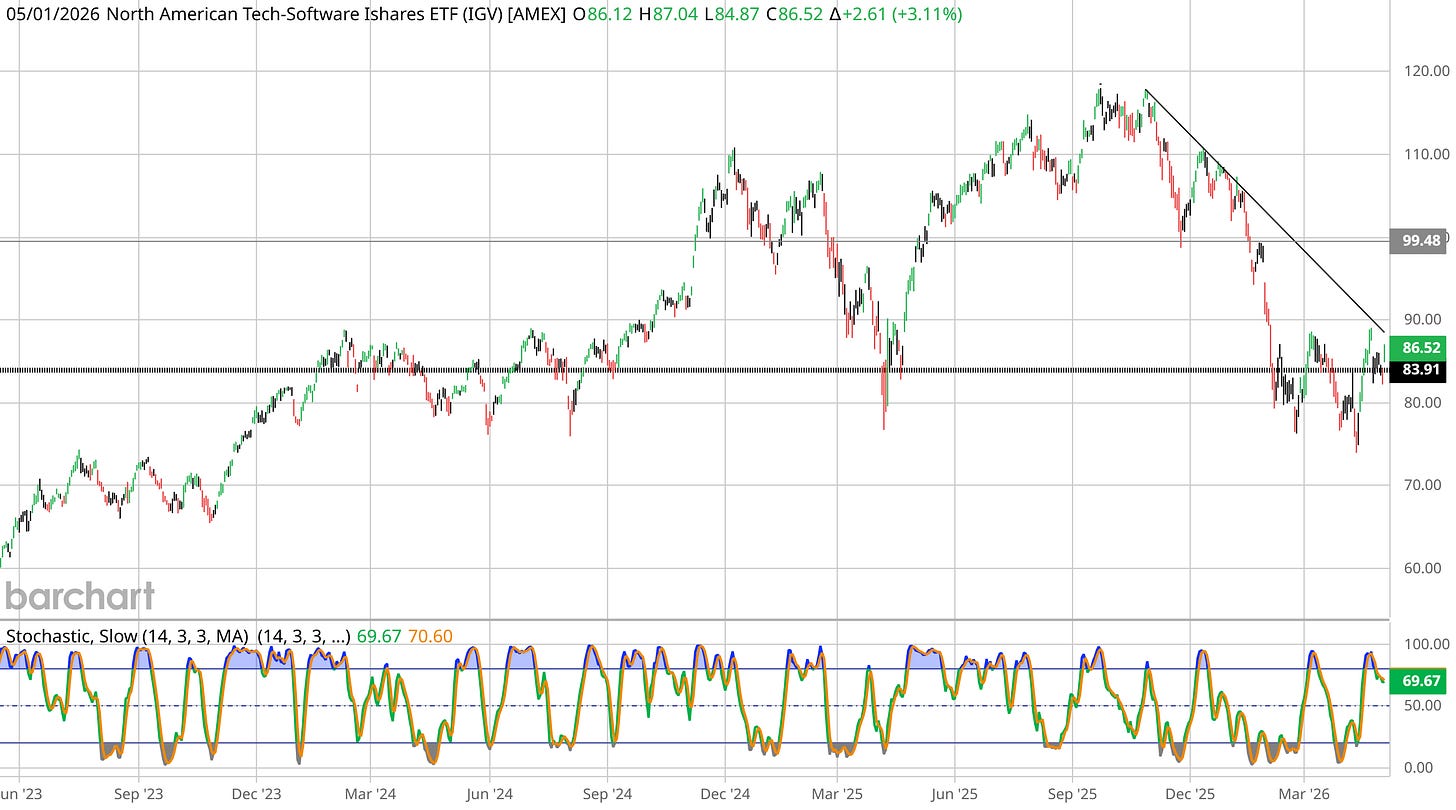
A week ago, we wrote that the software armageddon thesis was already losing edge. Ten days of earnings later, with all four hyperscalers reported, with Microsoft delivering the most consequential pricing-model statement of the cycle, and with the iShares Tech-Software ETF (IGV) breaking back through the 83.91 line that had marked the floor since the April panic — the picture has clarified.
The thesis isn't gone. It is being repriced into something narrower, slower, and survivable. Software did not need to crash to exit the armageddon regime. It just needed to stop falling while the largest player in the space told the market exactly what the new model looks like.
What changed in ten days
The hyperscaler print was decisive. Microsoft Cloud crossed $54 billion in the quarter, up 29% year over year. Microsoft's AI business surpassed a $37 billion annualized run rate, up 123%. Azure grew 40%. Alphabet and Amazon delivered AI-driven cloud growth that beat skeptical positioning. Meta took its 2026 capex guide up to $125–145 billion, from $115–135 billion previously — a raise on a guide that was already aggressive. Capex commitment from the AI-infrastructure customer base is not slowing. It is accelerating into 2027.
That matters for software because the armageddon thesis was never primarily about the hyperscalers. It was about the layer above them: ServiceNow, IBM, Salesforce, Adobe, MongoDB — the per-seat application businesses that the market began pricing for structural compression on April 9 when ServiceNow dropped 18% in a session and dragged the cohort with it. The thesis was that AI-driven automation eliminates seat counts, that agents replace users, and that the per-seat license becomes obsolete faster than the renewal cycle can absorb. It was a clean narrative. It was priced aggressively into the multiples of every name in IGV.
What the last ten days did was not invalidate the thesis. It refined it. The hyperscaler results show that AI capex is real and growing, indicating that downstream agentic infrastructure has a customer base willing to pay. The question is no longer whether per-seat is under pressure. It clearly is. The question is what replaces it, and whether the incumbents make the transition or get displaced.
Microsoft answered that question on Wednesday's call.
C — free account
The free C account unlocks the full Daily Pulse — every section of this read.
One tap with Google or one email — no password, no card. You are signed in until you sign out, on this browser, from then on.
Join the Look — freeAlready joined on this browser? The full edition shows automatically — if it doesn't, sign in again here. Looking for the archive, portfolios and realtime? That is C+.