The AI trade isn't running out of air. It's relocating.
What looks like fatigue at the top of the semiconductor complex is not the hype deflating — it's a graduated shift down the stack, from the capex layer to the layer that gets paid when those chips are actually used. The job here was never to time entries and exits in “the AI trade.” It's to position along the waves. Right now that means one thing: trimming tactical semiconductor exposure in the Rubin Build-Out and adding the names that earn when agents get deployed at scale.
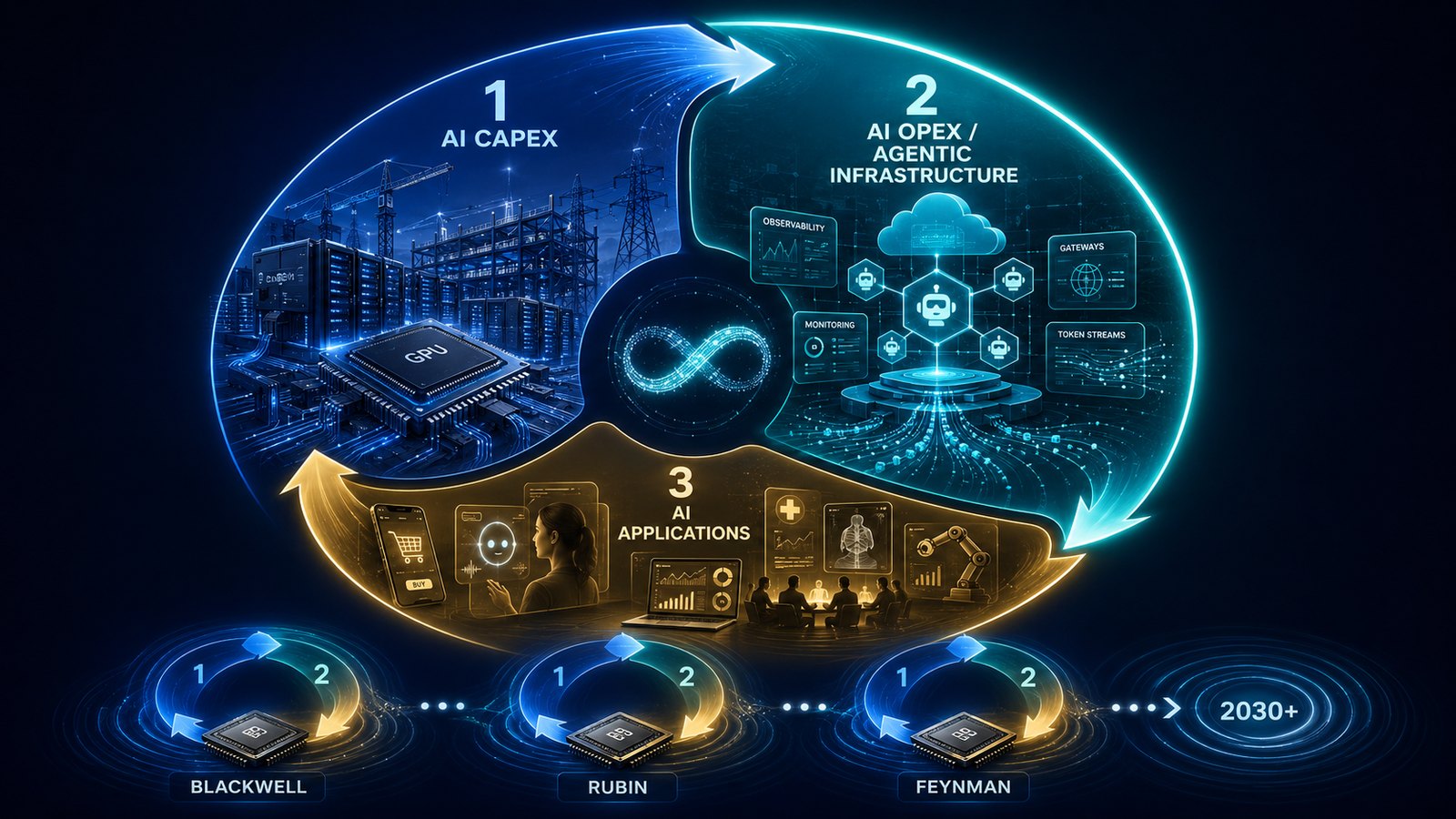
Three stages, repeating in waves
The cycle runs in three stages, and they are not a one-time event:
Stage 1 — the AI capex cycle. Compute gets built. Multiple sub-cycles — equipment, memory, packaging, substrates, power, cooling, optical — rotate through leadership. GPU-dominated, NVIDIA-centric.
Stage 2 — the AI opex cycle. Agentic infrastructure. The names that get paid per unit of machine activity once the compute is running.
Stage 3 — AI applications. End-user value capture.
The three stages are permanent layers; leadership rotates across them, and the whole sequence re-runs with each NVIDIA generation.
The trigger that moves the market from Stage 1 to Stage 2 is a step-change down in token cost — the point at which agents are not just deployable, but deployable at a margin. And the whole sequence repeats: each new NVIDIA generation — Blackwell → Rubin → Feynman — kicks off a fresh Stage 1, which in turn seeds the next Stage 2. That cadence runs to at least 2030. We are at the Stage 1 → Stage 2 handover now.
C — free account
The free C account unlocks the full Daily Pulse — every section of this read.
One tap with Google or one email — no password, no card. You are
signed in until you sign out, on this browser, from then on.
Already joined on this browser? The full edition shows automatically —
if it doesn't, sign in again here. Looking for the archive, portfolios and
realtime? That is C+.
The signals behind thisEach line links to the tool it comes from