Read · · 21 min read

Teradyne, Advantest, and the one layer of the AI build-out that never rotates

Part I of a new series inside the Rubin Build-Out coverage: which layers of the AI build-out survive the capex→opex handoff as strategic constraints — and which are only the cycle. Testing goes first.
Two prints, one signal
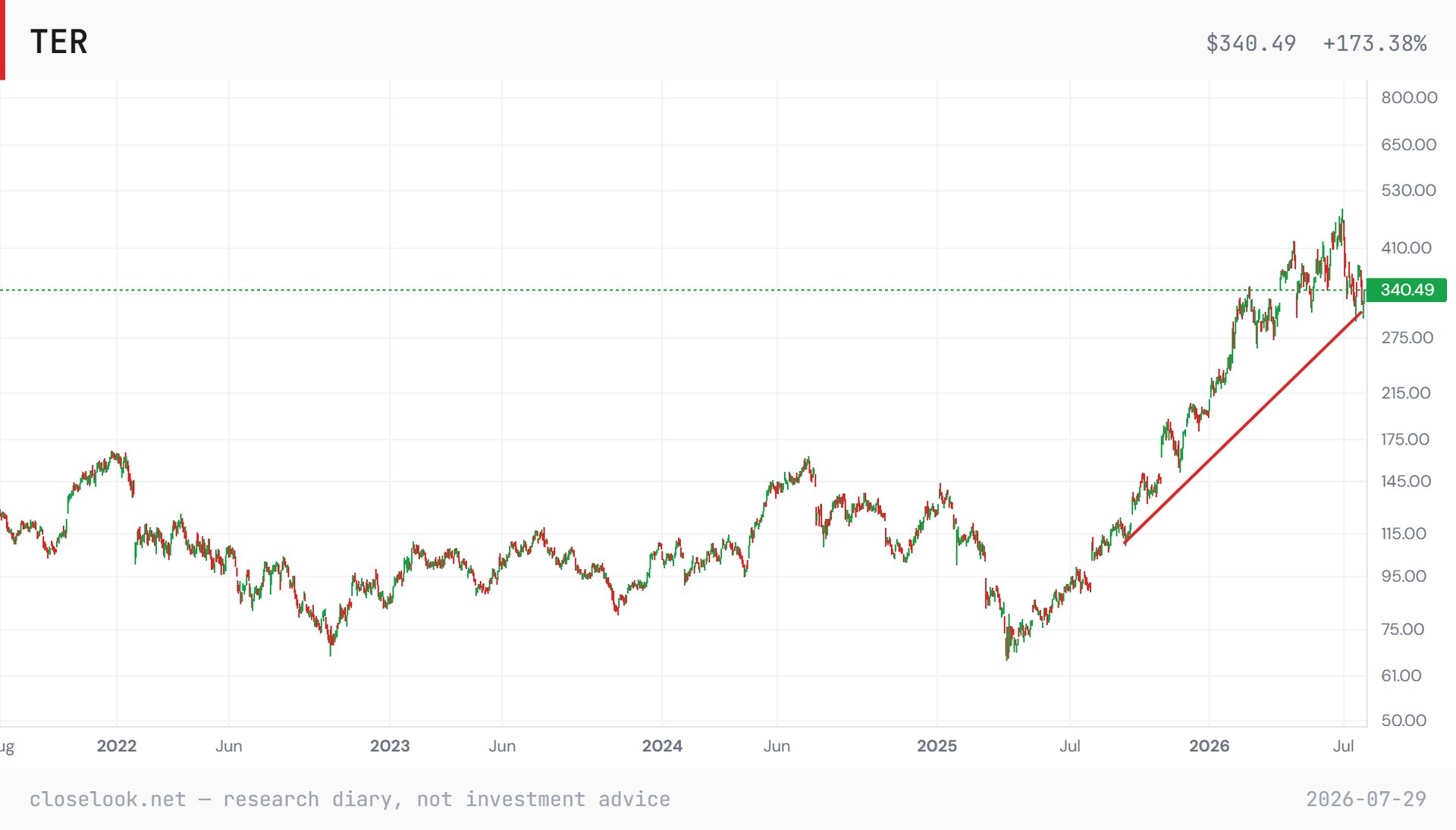
On 28 July, Teradyne reported second-quarter revenue of $1.329 billion — a 104% increase on the $652 million it earned in the same quarter of 2025, and its second consecutive record. Semiconductor Test contributed $1.122 billion, with record memory revenue on DRAM strength and a returning NAND final-test cycle. Non-GAAP earnings came in at $2.47 per share against a $2.05 consensus. Adjusted operating margin reached 33.7%, up from 13.9% a year earlier. Third-quarter guidance of $1.20–1.30 billion sat roughly 21% above where analysts had modelled it. The shares rose about 13%.
Hours later, Advantest delivered the second half of the sentence. Quarterly sales of ¥367.5 billion, up 39%. Operating income of ¥190 billion, up 53% — an operating margin above 51%. And a full-year guidance raise from ¥1.42 trillion to ¥1.714 trillion in sales, with operating income lifted from ¥627.5 billion to ¥846 billion. The shares added roughly 6% in European trading.
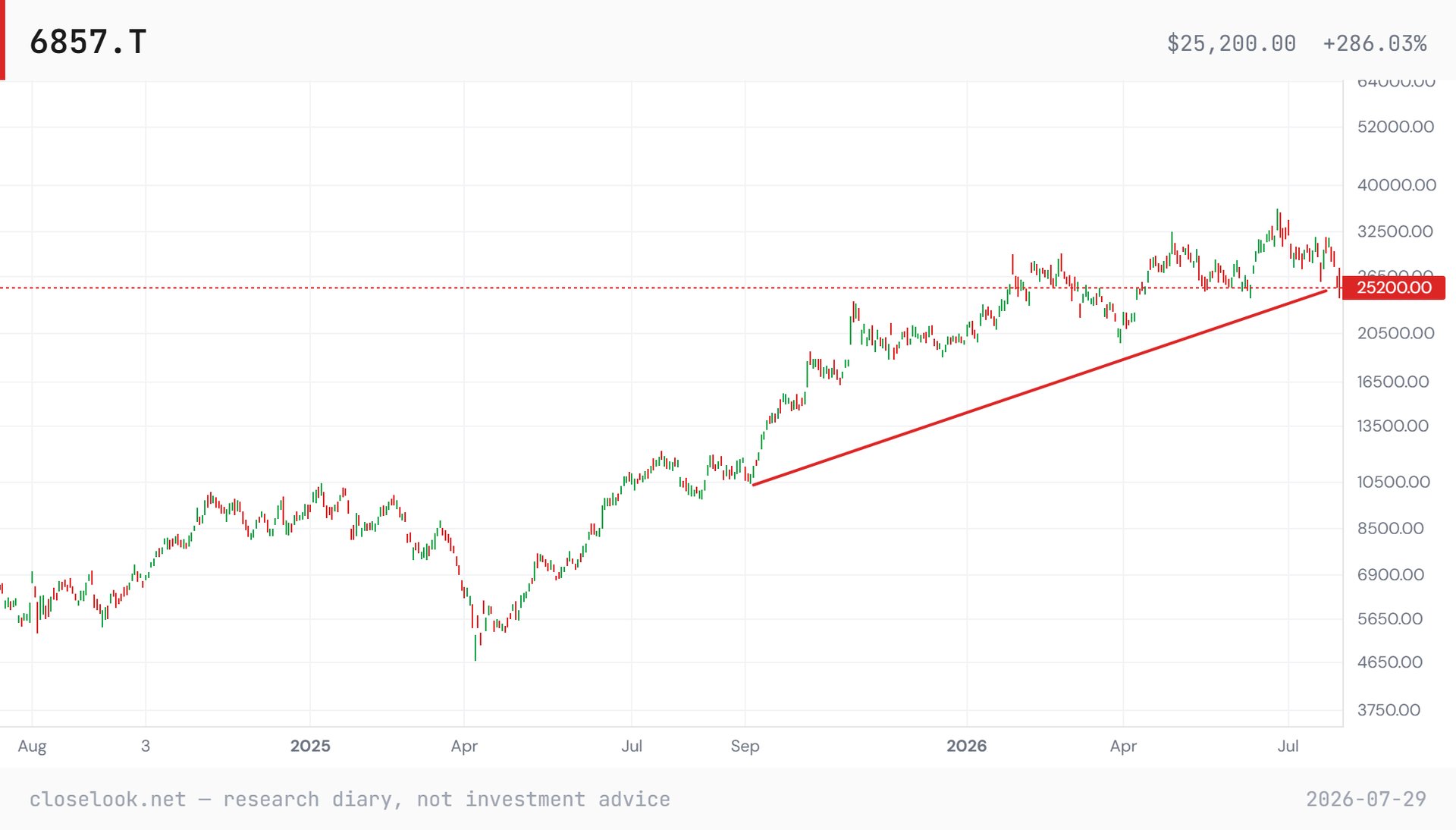
The instinct is to read this as two good quarters in a cyclical industry. It is not. Two direct competitors, in the same 24 hours, both raised the ceiling of the market they share. Share shift produces one winner and one apology. This produced two upgrades.
That is not a competitive event. It is a market-size event.
Inside this study
The full piece — free with the C account — works through:
- What was actually repriced — the 21% guidance gap that exposes a modelling failure, and the five margin points volume alone cannot produce.
- The layer that does not rotate — why filing test under “Equipment” is wrong: every other layer is a derivative of its phase; test is the integral of all of them.
- The relay's timekeeper — how test bills every holder of the constraint baton without ever carrying it.
- The far end of the barbell — why agentic chip design multiplies verification work instead of reducing it. A model can generate a floorplan. It cannot generate a passing wafer.
- The arithmetic of test intensity — four multiplying axes, and the one (value at risk per insertion) that makes test spending countercyclical to unit growth.
- Two doctrines, one market — Advantest's open ecosystem against Teradyne's vertical integration: the make/buy line drawn in opposite places, the silicon-photonics experiment where both bets run live, strongholds, weak spots, and the five contested fronts.
- The steelman — the sequential softness the headlines skipped, the capacity-expansion timing risk, and the capture-rate objection that attacks the thesis at its foundation.
- What survives the handoff — the series rubric: strategic constraint players against cyclical capex riders, and where the testing duopoly, TSMC and Nvidia sit.
- How we hold it — the classification, the sizing discipline, and the nine indicators we watch from here.
Headline numbers: Teradyne +104% revenue with a Q3 guide ~21% above consensus (and ~6% below the quarter it just printed — both facts matter). Advantest at a 51%+ operating margin, raising full-year operating income ~35% one quarter into the year. Two competitors, one repriced market.