Daily Pulse · · 08:30 CET · framework · ROK
Rockwell Automation is starting to look like one of the more interesting second-wave AI stocks — not because it makes GPUs, and not because it runs cloud models, but because it sits in the physical AI layer where AI meets the real economy.
ROK is interesting because it sits at the intersection of where AI increasingly goes next: factories, warehouses, data centers, semiconductor facilities, energy infrastructure, robotics, motion control, machine control, industrial software and automated production lines. That is the physical AI layer. The first AI trade was about building the digital brain — GPUs, networking, cloud infrastructure, memory, data centers. One of the next trades is about connecting that intelligence to physical systems: controlling, optimising, simulating, monitoring and automating them.
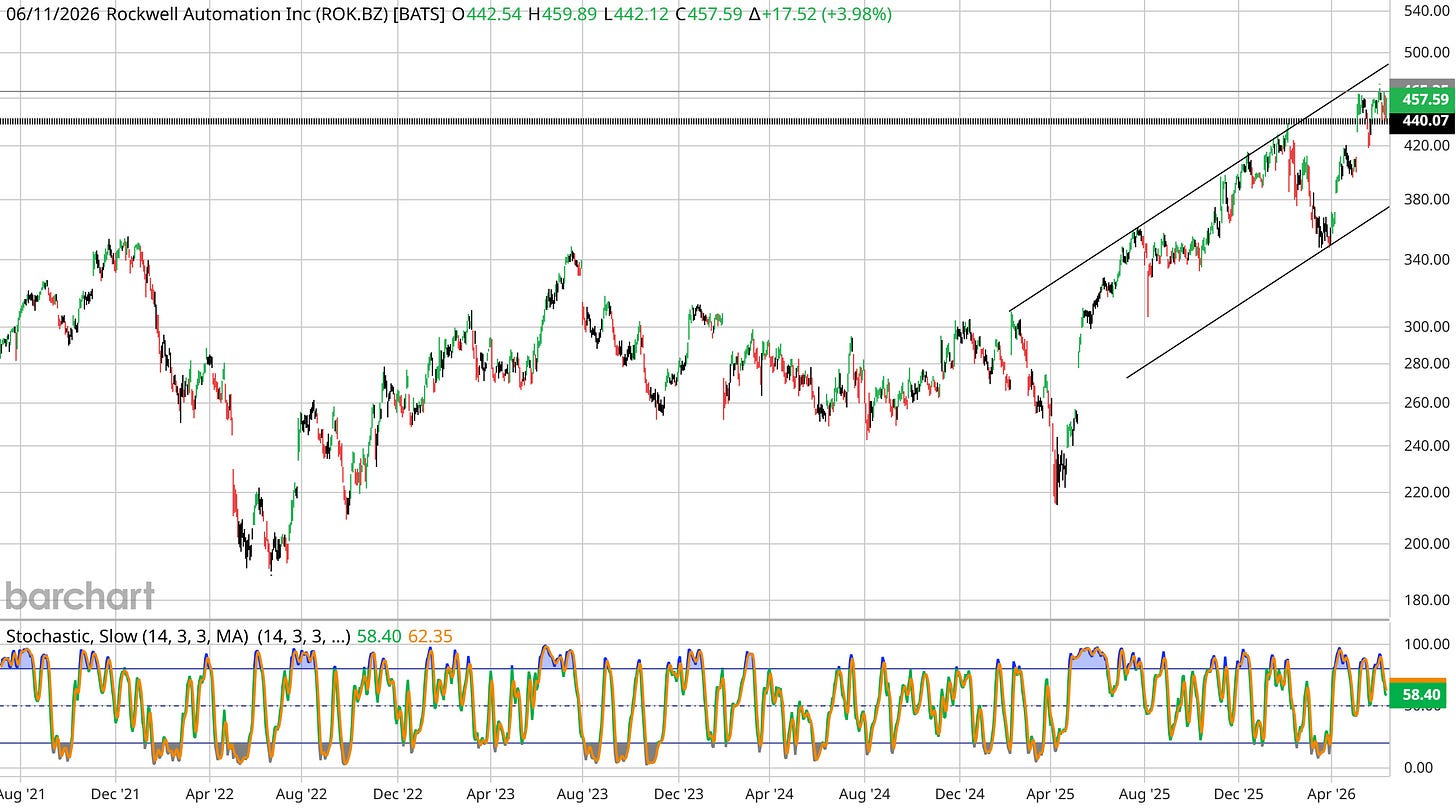
The chart is now confirming that investors are beginning to recognise the story. ROK has pushed above the key $440 resistance, closing near $457.59 after a strong session. The stock has been trending within a rising channel since spring 2025, and this latest move looks like a potential breakout from a longer consolidation zone.
What's the buzz?
Rockwell's latest quarter was meaningfully better than expected. In fiscal Q2 2026 the company reported sales of $2.24 billion, up 12% year over year, with organic sales up 9%. Adjusted EPS came in at $3.30, up 32% year over year, while enterprise operating margin expanded to 22.5%, up 350 basis points from a year earlier.
More important, management raised guidance. Rockwell now expects fiscal 2026 reported and organic sales growth of 5% to 9%, up from the prior range of 2% to 6%. It also raised adjusted EPS guidance to $12.50–$13.10, with the midpoint now around $12.80, about $1 higher than before. This is not a stock moving only on a theme — it is moving on stronger sales growth, higher margins, better earnings and stronger guidance.
So what?
The first AI trade built the digital brain: GPUs, networking, cloud infrastructure, memory and data centers. One of the next trades connects that intelligence to the real economy. AI needs to control, optimise, simulate, monitor and automate physical systems — industrial controllers, factory software, robotic systems, warehouse automation, semiconductor tools and facilities, energy infrastructure, data center operations, machine safety, motion control, drives, sensors and industrial networks. This is Rockwell's world.
Management said momentum was led by improving demand in warehouse automation, data centers, semiconductors and energy — a list that reads like a physical AI checklist. The Intelligent Devices segment grew 13% year over year (drives, motion, safety, sensing, smart devices — the building blocks that let machines act). And the higher-value Software & Control business is accelerating: revenue up 20% year over year, with segment margin expanding to 34.9% from 30.1%. That is probably the most important number in the report. If Rockwell were only an old-economy hardware supplier, the AI case would be weaker; the faster growth in Software & Control suggests a more attractive mix of software, controllers, factory intelligence, analytics and recurring revenue.
Management also pointed specifically to data centers, highlighting demand for industrial-grade controllers — including a win with ATS Automation using Rockwell's Logix PLCs at a new AI data center in Texas. Data centers are not just buildings full of chips; they are industrial facilities that need power management, cooling, backup systems, safety, uptime, automation, monitoring and control. Rockwell is not selling the GPU — it is selling part of the operating layer that helps the AI factory function.
Why Rockwell is an AI beneficiary
1. AI data centers are industrial automation projects. The buildout is not only a semiconductor story — it is also a power, cooling, electrical, control, monitoring and uptime story. Large AI data centers need reliable industrial control systems around electrical, HVAC, thermal management, backup power, water and facility operations, which is where Rockwell's controllers and software fit.
2. AI increases demand for warehouse automation and robotics. Better vision, route optimisation, picking, robotics coordination and predictive maintenance all raise the value of automated warehouses — one of the clearest real-world use cases for physical AI, and an area management called out directly.
3. Semiconductor and electronics capacity need automation. AI demand is driving more semiconductor investment, and fabs, advanced packaging and electronics manufacturing are highly automated environments. Rockwell does not need to sell chips to benefit from the chip cycle — it benefits from the process automation required to build and scale that ecosystem.
4. AI makes industrial software more valuable. The more companies use AI in operations, the more they need clean data, connected machines, digital twins, simulation, monitoring and control. Industrial AI is not useful unless it can connect to real production systems — which is exactly what the 20% growth in Software & Control reflects.
Guidance: better than before, but not cheap
The upgrade is meaningful. Rockwell's new FY26 adjusted EPS range is $12.50–$13.10. At a share price around $457.59, the $12.80 midpoint implies a forward P/E of roughly 35.7x FY26 adjusted EPS; using consensus, third-party data shows ROK around 33.9x 2026 and 30.3x 2027 earnings. So the stock is expensive, but not absurd if earnings growth continues. ROK is now valued less as a slow industrial and more as a high-quality automation compounder with AI-infrastructure exposure — which is both the opportunity and the risk. If the market believes Rockwell can deliver several years of growth from data centers, warehouse automation, semiconductors, energy and industrial software, the premium can hold; if growth fades, the valuation becomes vulnerable.
Technical setup
The chart is constructive. ROK has broken above the long resistance zone around $440, which had acted as a ceiling, and the close near $457.59 puts it above that breakout level and near the upper part of its rising channel. The most important level now is no longer the old high — it is the breakout zone. A successful retest of $440–$445 would be the bullish tell: old resistance becoming new support. The stochastic has cooled from extreme levels to the middle of its range, giving the stock room to extend, but ROK has already moved sharply from the spring lows, so chasing the first breakout candle carries more risk than buying a controlled pullback.

Closelooknet Lens
ROK belongs on the physical AI watchlist. The market has already rewarded the companies that build the AI brain; it is now starting to look for companies that help AI act in the physical world, and Rockwell sits directly in that path. It benefits from AI data centers because those facilities need industrial-grade control and automation; from warehouse automation because AI makes robotics and logistics smarter; from semiconductor investment because AI chip production requires advanced automation; and from industrial software because AI needs connected machines, factory data, simulation, control systems and real-time operational intelligence. This is not the flashiest AI stock — it may be one of the cleaner, higher-quality industrial ways to play the broadening of the AI cycle.
Actionable view
Bias: bullish, but valuation-sensitive. Why it matters: ROK is breaking out technically while fundamentals improve — stronger sales, better margins, higher EPS and raised guidance. Forward valuation: ~35.7x FY26 adjusted EPS at management's midpoint, ~30x FY27 consensus. Key level: $440–$445. Best entry setup: a retest and hold of the breakout zone. Bull case: ROK becomes a premium physical-AI infrastructure compounder as data centers, warehouses, semiconductors and smart factories drive automation demand. Bear case: the multiple is already rich — if industrial capex slows or AI-related orders disappoint, the stock could derate quickly.
Bottom line. Rockwell Automation is not just an industrial stock making a new high. It is increasingly being priced as a physical AI beneficiary — and the latest earnings call gave investors more evidence to support that view.