Options
When You Think the Rally Pauses, Sell Calls — Not Your ETF
Selling a winning core position triggers tax, transaction cost, and the risk you're wrong about getting back in. Writing calls against it monetises the pause you expect while you keep the position. With semis up 126% and overbought, here's the overlay — and when to upgrade it to a collar.


As of late May 2026 the VanEck Semiconductor ETF (SMH) sits near $576, having just printed an all-time high around $582 and up roughly 126% over twelve months; QQQ is near $717, also close to highs. The semis are flashing exhaustion — record-overbought readings, the Street penciling in a 5–11% pullback — even as options traders pile into ever-pricier calls to chase the move. Suppose you hold SMH as a long-term position and you share that caution. The instinct is to sell. But selling a winner you still believe in over the long run is an expensive way to express a short-term worry — and there's a cleaner tool.
The overlay, not the exit
A covered-call overlay means selling call options against a core holding you intend to keep. You collect premium today against the upside above your strike. If the ETF stalls or drifts down, as you expect, the calls expire worthless and you keep both the premium and your shares. If it keeps running, the calls cap your gain at the strike — but you still own the position, and rather than let the shares get called away you roll the calls up and out: buy them back and sell a higher-strike, later-dated call for roughly the same price, lifting the cap while keeping the position. That roll is a craft of its own, with its own arithmetic, covered in Rolling Up and Out. The point is that you've monetised an expected pause without doing the one thing that's genuinely costly: liquidating a long-term winner.
Why selling the position is the worse trade is mostly about the frictions that don't show up in the headline. Selling realises capital gains — a tax bill you chose to trigger on a short-term hunch. It incurs the round-trip cost of getting out and back in. And it hands you the hardest problem in investing: deciding when to buy back. Most investors who sell a strong trend to "wait for the pullback" either never get the pullback they wanted or freeze when it comes and miss the re-entry, watching the position run away without them. The overlay sidesteps all three: you never leave the position, so there's nothing to time your way back into.
Match the structure to the strength of your view
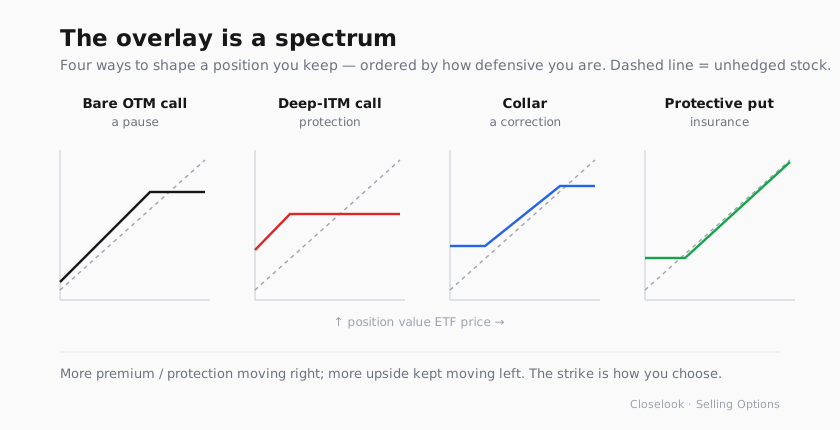
Here's the part most overlay explanations skip: the overlay isn't one trade, it's a spectrum, and where you sit on it should track how defensive you actually feel.
A bare out-of-the-money covered call protects you only by the size of the premium — a point or three. That comfortably handles a stall or a shallow drift and leaves most of your upside intact. It does almost nothing against a real correction: if SMH falls 15%, two or three points of premium is a rounding error against the loss on the shares.
If you want real protection without selling, sell the call deep in the money instead. A deep-ITM call carries a large premium — mostly intrinsic value — so the cash you collect is a thick downside cushion. Sell the call far enough in the money and you've effectively pre-sold the position at the strike while still holding it: a big buffer if the ETF drops, in exchange for surrendering nearly all the upside. It's the most defensive corner of the covered-call spectrum — for when you're bearish enough to want out but don't want to trigger the sale.
If you expect a genuine correction but want to keep your upside, the cleaner structure is the collar: sell an out-of-the-money call and use the premium to buy a protective put below the current price. On a name where call implied vol is rich after a vertical run — exactly today's semis — that put can be close to free, financed by the call you were going to sell anyway. The collar caps your upside and floors your downside; it's the difference between cushioning a stumble and catching a fall. And if you want protection with no cap at all, you can simply buy the put on its own — pure insurance that keeps every cent of upside, at the cost of the premium you pay for it.
So the menu runs by conviction: a bare OTM call for a pause, a deep-ITM call or a collar for a correction, a lone put when you'll pay to keep unbounded upside. "Sell calls when you think markets correct" is really a range of structures, and the strike is how you order from it.
Why ETFs are the right canvas
Three features make liquid thematic and regional ETFs better overlay vehicles than single stocks. Their option chains are deep and two-sided, so entry, exit, and rolling don't bleed you on spreads. The underlying is diversified, so there's no single-name earnings gap — the violent overnight surprise that makes an overlay on one stock so dangerous is muted across a basket. And the exposure is targetable: you can write where you think the froth actually is — semis through SMH or SOXX, big-tech through QQQ or XLK, a region or theme through its own fund — and leave the rest of your core untouched.
What "diversified" does not mean is "safe." SMH carries a beta near 1.7 and has already taken roughly a 15% drawdown inside the past three months on its way to these highs. A thematic ETF still gaps on macro — a rate scare, a trade-policy headline, an AI-spending wobble moves the whole basket at once. The overlay tames single-name surprise, not market risk. Which is exactly why the collar, not the bare call, is the honest structure when your worry is a genuine drawdown rather than a breather.
Which ETFs — and why liquidity is the real filter
The list of ETFs you could overlay is long. The list you actually can is shorter, and the thing that separates them is option liquidity. A covered call or collar only works if the chain is deep and two-sided — wide spreads and thin open interest turn every entry, roll, and exit into a tax on the strategy. So sort the universe by what the chain can bear, not by what the fund holds:
Overlay-grade — the deepest chains in the market: the broad-index ETFs. SPY, QQQ, and IWM (Russell 2000) carry world-class option liquidity; DIA (Dow) is a step behind but workable. Note that IVV and VOO are excellent to hold for their low fees, but their option chains are far thinner than SPY's — for the overlay itself, write on SPY, or use the index options (SPX, NDX) directly.
Workable — liquid enough to run cleanly: the SPDR Select Sector funds — XLK (tech), XLF (financials), XLE (energy), XLV (health), XLI (industrials), XLY (discretionary), XLP (staples), XLC (communications), XLRE (real estate) — plus the big industry names: SMH and SOXX (semis), IBB (biotech), VNQ (REITs), and ARKK. These let you target a sector's froth without leaving your core.
Map-only — read it, don't trade it: most of the niche thematics. A heat map like Closelook's KW21 tech-thematics screen is invaluable for seeing where the run is — semis blistering (XSD +87.8%, SOXX +78.4%, SMH +60.0% YTD), data-center, AI, and quantum hot (DTCR +44.4%, WTAI +42.8%, QTUM +39.9%), while software, fintech, and gaming lag the tape (IGV −11.1%, FINX −15.7%, ESPO −14.0%). But XSD, AIQ, WTAI, DTCR, GRID, QTUM, SNSR, and most of that cohort have chains too thin to overlay. The discipline: read the theme off the radar, then express it through the most liquid proxy that captures it. Right now the standout is that the single most-extended theme — semis — is also one of the few that's genuinely optionable, through SMH and SOXX. That alignment is the textbook overlay setup, and it won't always be there. And the laggards are the tell on the other side: you don't write calls on what's already been beaten down — capping IGV or ESPO after a −15% year sells cheap upside you may want back. The overlay belongs on what's run hot and liquid, not on what's already bled.
Two regional notes, since the core isn't always US: URTH (MSCI World) gives broad global exposure but a thin options chain — fine to hold, awkward to overlay. And the German index is the cautionary case: a DAX ETF is too illiquid to write on at all; if you want the overlay on German exposure, the route is options on the DAX index itself (Eurex), not the fund.
A note on tax, because it changes the arithmetic
In the US, options on equity ETFs like SMH and QQQ are taxed as ordinary equity options — short- or long-term by holding period — not under the 60/40 Section 1256 treatment that broad-based index options (SPX, XSP, NDX) receive. If you're running the overlay at size, the index-option version can be materially more tax-efficient for the same exposure. For European investors the premium lands under Abgeltungsteuer regardless. Model the after-tax premium, not the gross — the headline yield on an overlay is rarely the yield you keep.
One question worth sitting with
The overlay is a portfolio tool, not an income strategy, and the difference is the whole discipline. Its job is to shape risk around a position you want to hold for years, not to manufacture yield from one you don't care about. So the question to ask before writing a single call is: am I selling this upside because I genuinely expect the pause — or because the premium is fat and I've quietly talked myself into a view to collect it? If it's the former, the overlay is one of the most elegant tools in the book. If it's the latter, you've stopped managing the position and started trading against it — and the AI trade, more than most, has a long history of punishing the people who capped it early. The Money Temperature monitor helps frame whether the pause you're bracing for is actually building, or whether the trend still has the wind behind it.
Closelook publishes a market diary, not investment advice. The strategies described here are educational. Tax, suitability, and risk depend on personal circumstances — consult a licensed advisor before acting.