Options
Option Selling — Win Small, Often. Lose Big, Once.
The premium seller's edge is real — and so is the tail that eventually erases a year of it in an afternoon. The standard risk toolkit can't see that tail, because it was built on a curve markets don't obey. With the fear gauge near its lows, this is exactly when the bell curve lies to you.


As of late May 2026 the VIX sits around 16–17, near the floor of its 52-week range. Calm tape, complacent gauge, premium-selling strategies posting their smoothest stretch. This is precisely the environment in which sellers get hurt — not during the calm, but because of it. A quiet fear gauge lulls you into sizing up, and the steady drip of small wins builds a confidence the math doesn't support. Selling options is positive-expectancy, as the edge piece argued. It is also, in its risk shape, the single most misunderstood trade most investors ever put on.
The shape of the seller's outcomes
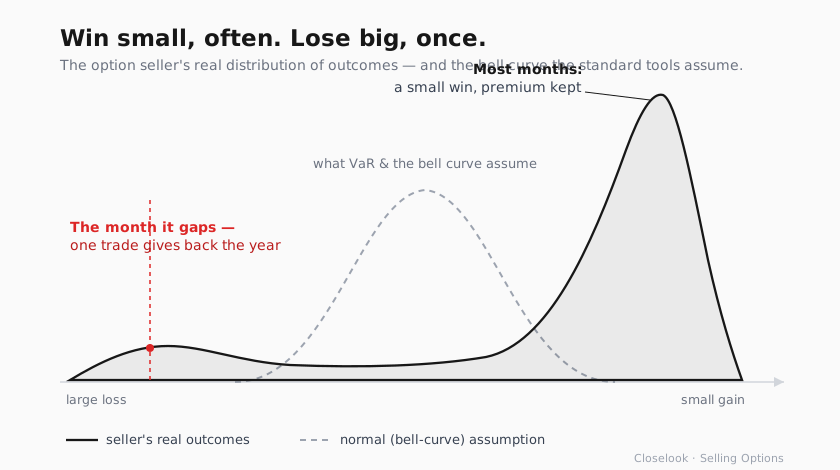
Here is the seller's payoff, and it's the exact inverse of the buyer's. The buyer loses a little, often, and occasionally wins big. The seller wins a little, often — and occasionally loses big. You collect a stream of modest premiums month after month, building a smooth and convincing equity curve that feels almost like a yield. Then, on one of those months, the underlying gaps — an earnings miss, an investigation, a sector unwind — and a single trade gives back a year or more of accumulated wins before lunch.
Nebius makes the point twice over. A harvester who sold out-of-the-money puts as it climbed from about $20 to the low 200s would have "won" almost every single month — the stock rocketed up, the puts expired worthless, the premium kept landing, the win rate looked immaculate. But that same ~41% annualised premium was the market saying, every month, that a violent move was a live possibility. On a name like this a −25% to −40% month is not a tail event; it's closer to a quarterly occurrence. The day it gaps down through your strike, you're assigned far above market, and the premium that looked like yield reveals itself as what it always was: the fee you were collecting for selling insurance against a catastrophe that eventually arrives.
Why the textbook tools can't see it
The standard institutional toolkit — Value at Risk, standard deviation as the risk measure, the Sharpe ratio, mean-variance portfolio construction — was built on an assumption that is wrong in exactly the place a premium seller gets hurt. All of it rests, one way or another, on the bell curve: the idea that returns are normally distributed, that a move is some tidy number of standard deviations from the mean, and that the far tail is so improbable it rounds to zero. A 95%-confidence VaR tells you the most you'll lose on 95% of days and says nothing at all about the other 5% — which is precisely where the −40% gap lives. It's a smoke detector that switches itself off during the fire.
Markets are not bell-curved. Real return distributions have fat tails: extreme moves occur far more often, and run far larger, than a normal distribution permits. The 1987 crash, the 2008 unwind, the 2020 gap — each was, on Gaussian math, a multi-sigma event that "shouldn't" happen in the lifetime of the universe, and they arrive every decade or so. Mandelbrot showed this more than half a century ago and the textbooks largely carried on regardless. For a short-volatility book the consequence is specific and brutal: the bell curve systematically under-prices the only event that can ruin you. Your win rate looks spotless, your volatility looks low, your Sharpe looks wonderful — right up until the distribution remembers it has a tail.
The toolkit that actually fits
What applies to a seller's book is a different set of tools, all of which start from the tail rather than the average. Defined-risk structures cap the loss before it runs open-ended — buying a further-out wing turns a naked short put into a spread with a known worst case. Tail hedges, held as a standing cost in the barbell spirit, are cheap far-out protection that does nothing for years and everything in one week. Expected shortfall and honest stress-testing ask the right question — what does a −40% overnight gap do to the whole book at once, with correlations snapping toward one — where VaR asks the comfortable one. And position sizing is done off the downside, never the premium: total assignment exposure capped, fractional-Kelly on the loss not the yield, no single name allowed to dominate. See the Kelly criterion and drawdown entries.
The discipline underneath all of it is one sentence: a premium seller is sized by the one bad trade, never by the many good ones. Win rate is the most seductive and least informative number in the whole strategy — you'll win most months by design. The question is never how often you win; it's whether the month you lose leaves you standing to collect the next year of wins. On Apple, the tail is a bad week. On Nebius, the tail can be the account, if the position was sized off that intoxicating 108% headline instead of off the −40% gap.
This is the short-gamma, short-vega bargain stated plainly. As a seller you are short gamma — your position turns against you faster the more the underlying moves — and short vega — a spike in fear inflates exactly the options you're short. The premium you collect is the variance risk premium, and the variance risk premium is compensation for precisely the loss that, given enough months, shows up. The edge is real. The tail is also real. They are the same coin, and risk management is simply the refusal to spend the first while pretending the second isn't there.
One question worth sitting with
The calmer the gauge, the bigger the lie — because a low VIX doesn't mean the tail has gone, only that the market has briefly stopped pricing it, and that you're being paid less to carry it. So the question isn't whether your strategy makes money in a quiet tape; it will, easily, and that ease is the trap. The question is whether, when you sized the position last week, you sized it for the print that isn't on any normal-distribution chart. If the answer depends on that print not coming, you don't have a strategy — you have a streak, and streaks end on the day the premium was always warning you about.
Closelook publishes a market diary, not investment advice. The strategies described here are educational. Tax, suitability, and risk depend on personal circumstances — consult a licensed advisor before acting.