Weekly Signal · · 10 min read


In this edition
The build-out splits into three, and the second half belongs to the layers that use it.
29 June 2026 — closes through Jun 26.
Last week, the market was two-speed. A slim majority of stocks still participated, the broad tape was not broken, but a narrow engine carried the index gains: the AI build-out.
The S&P 500 closed Friday at 7,354, down 2.0% on the week, while the Nasdaq fell 4.5%. Apple and Microsoft raised consumer product prices, citing memory and storage chip costs that have more than doubled since autumn 2025 and are expected to more than double again by the end of the year. The main driver has been the demand for DRAM and NAND from AI data centers.
Rubin, our capex index, was the load-bearing wall — until Thursday. The question was whether semiconductors could keep carrying the structure; on Friday they tumbled.
It is now the last weekend of the first half. Rubin closed the half +124% from its December inception, the cleanest trade of H1. But as the half ends, the question changes shape. It is no longer can capex keep carrying the market. It is does leadership rotate from building the factory to using it.
Because the AI trade is still alive, and it is no longer one trade. It has split into three clocks: capex, opex, and applications.
A note on the word, because it matters for the canon. These are not the clock of Heresy IX. There, clock meant the thing that sets the cadence — NVIDIA, and the memory layer beside it. Here it means timing of onset: the capex clock ticks first, the opex clock second, the application clock last. Same word, different axis — and the two frames lock together, because these three clocks are the macro phases the constraint relay passes through. Capex is the supply relay building the stack. Opex is the recurring-rails layer that gets paid when the stack runs. Applications are the demand link — the one arrow in the relay that does all the work, and the one most likely to break.
What the first half actually did
The split is already on the tape. You do not have to forecast it. You can read it in two lines.
Rubin closed the half +124% from inception. Software — IGV — closed it −18% over the same six months. The market paid a violent price for the factory and sold software that has not yet proven it captures agentic value. XLK and QQQ finished green — tech up, but up because the capex engine carried it, not because the breadth was healthy.
That divergence between Rubin and IGV is the three-way split, compressed into two numbers. The build-out and the application layer did not move together in H1. They moved in opposite directions.
And yet the capex index is no longer accelerating. Rubin peaked near 2,450 in early June and sits at 2,241 now — the trend is intact, the acceleration is gone. The Agentic Ecosystem equal-weight tells the same story one layer down: it ran from 1,000 to a peak near 1,450 in early June, then corrected to 1,278. Up strongly on the half. Off roughly 12% from its high.
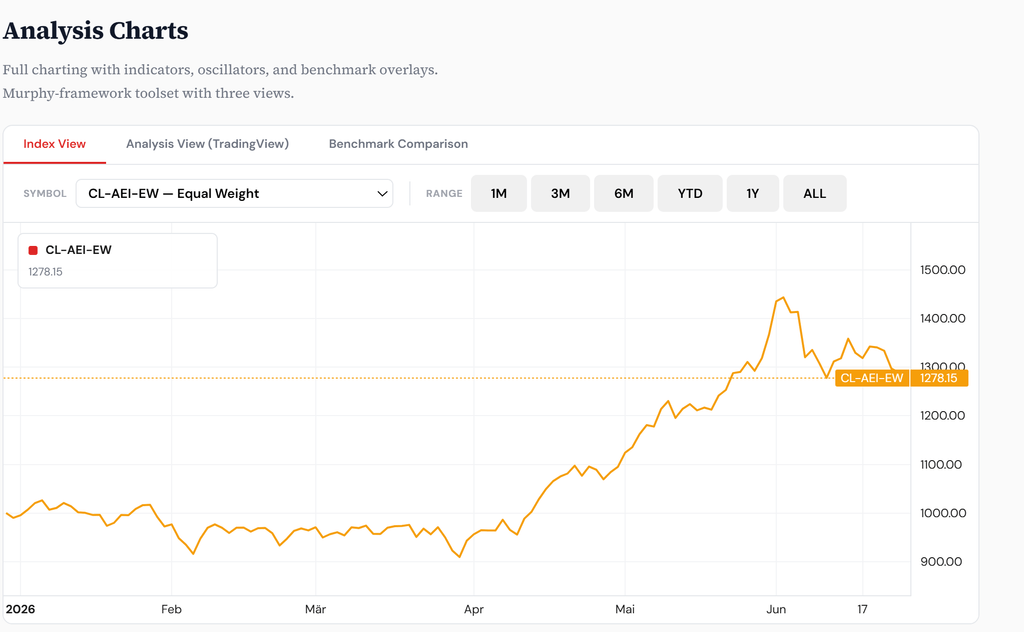
That is what a maturing build-out trade looks like. The theme survives. The market stops rewarding everything attached to it with the same force and starts asking which constraint is next, which is already priced, and which part of the chain is now vulnerable to being digested.
C — free account
The free C account unlocks the full Weekly Signal — the complete read and its scoring.
One tap with Google or one email — no password, no card. You are signed in until you sign out, on this browser, from then on.
Join the Look — freeAlready joined on this browser? The full edition shows automatically — if it doesn't, sign in again here. Looking for the archive, portfolios and realtime? That is C+.